1. Introduction: The Great Information Retrieval Shift
The digital information landscape is currently undergoing its most significant transformation since the advent of the commercial internet. We are witnessing a structural migration from the "Search Economy," defined by the indexing and ranking of hyperlinks, to the "Citation Economy," defined by the synthesis and attribution of knowledge by Artificial Intelligence, namely Large Language Models. The period spanning 2025 and 2026 marks the tipping point where "Answer Engines"- systems like OpenAI's ChatGPT, Google's Gemini, Perplexity, and Anthropic's Claude- evolved from novelties into the primary gatekeepers of digital discovery.
This report provides a comprehensive, data-driven analysis of the sources these systems prioritize, the algorithmic logic driving their choices, and the specific implications for product visibility. The analysis draws upon an extensive dataset of citation frequencies, user behavior statistics, and technical studies to construct a roadmap for brand survival in a "zero-click" world.
1.1 The Decline of the Blue Link and the Rise of Synthesis
For two decades, the objective of digital marketing was clear: rank highly on a Search Engine Results Page (SERP) to earn a click. The metrics of success were impressions, Click-Through Rates (CTR), and session duration. In 2025, these metrics are being rendered secondary by the "Zero-Click" phenomenon. Recent data indicates that approximately 58% of Google searches in the United States now end without a click to an external website. This trend is even more pronounced within AI-native environments; in Google's AI Mode, widely rolled out to compete with ChatGPT, nearly 93% of user sessions conclude without the user ever leaving the interface.
This creates a fundamental paradox for businesses: visibility has never been higher, but traffic has never been harder to earn. When a user asks an LLM for "the best CRM software for small businesses" or "reviews of the 2026 Tesla Model Y," the model does not present a list of links to Gartner or Car and Driver. Instead, it reads those sources, extracts the consensus, synthesizes a direct answer, and provides a footnote. That footnote- the citation- is the new currency of the web.
1.2 The Answer Engine Market Landscape
As of early 2026, the ecosystem is dominated by a duopoly, though challenger engines are carving out significant niches for technical and academic queries.
- ChatGPT (OpenAI): Commanding a generative AI market share of between 60% and 82% depending on the region, ChatGPT functions as the default "knowledge engine" for the general public. It processes over 2 billion queries daily. Its architecture favors established "institutional" authority for general knowledge but shifts drastically toward commercial marketplaces for product queries.
- Google Gemini (AI Overviews): Google's counter-strategy has been to integrate its Gemini models directly into the SERP via "AI Overviews" (AIOs). As of late 2025, these overviews appear for over 50% of all queries and nearly 100% of informational queries. Gemini is distinct in its heavy reliance on Google's own proprietary ecosystem- specifically YouTube and Google Shopping- to inform its answers.
- Perplexity & Claude: Perplexity has emerged as the "power user's" engine, with a citation density significantly higher than its competitors, often citing 5-7 unique domains per answer compared to ChatGPT's 2-3. Claude, conversely, adopts a "safety-first" approach, often refusing to cite non-verified sources, creating a higher barrier to entry for brands.
1.3 The Core Research Question
The central inquiry driving this report is: What sources do these engines trust, and how can a brand ensure its product information is included in the synthesis?
This analysis will show, while the philosophy of Answer Engine Optimization (AEO) is sound, many of the technical tactics touted in 2024 have failed to demonstrate statistical impact in 2025. The reality of optimization is far more complex, rooting itself in "Entity Authority" and "Quote-Readiness".
2. Citation Architecture: Who the Machines Trust
To understand how to be cited, one must first understand the hierarchy of trust that governs Large Language Models (LLMs). Unlike search engines, which use backlinks as a proxy for authority, LLMs use "consensus" and "token probability." They look for patterns of agreement across datasets they have been trained on or can retrieve in real-time (RAG).
2.1 The Foundational Layer: Wikipedia
Across almost every study of AI citation sources conducted in 2025, one domain stands unrivaled: Wikipedia.
In general informational queries, Wikipedia captures between 43% and 47.9% of all citations generated by ChatGPT.
This dominance is structural. LLMs are trained using Reinforcement Learning from Human Feedback (RLHF), where human raters prefer answers that are neutral, comprehensive, and factually grounded. Wikipedia's editorial standards perfectly mimic this desired output style. Therefore, the models have learned to treat Wikipedia as the "ground truth" for entity definition. If a product or brand does not have a Wikipedia entry- or at minimum, a presence on Wikidata- it struggles to establish "object permanence" within the model's latent space.
However, Wikipedia's dominance is not absolute. Data reveals a massive drop-off when intent shifts to commerce. For shopping queries, Wikipedia's share plummets to ~22%, as it lacks the real-time pricing and sentiment data required for product recommendations.
2.2 The Validation Layer: Reddit
The role of Reddit in the AI ecosystem is the most volatile and significant development of the 2025-2026 period. Reddit represents "Human Consensus." LLMs, being devoid of lived experience, cannot "know" if a coffee grinder is quiet or if a software update is buggy. They rely on Reddit threads to simulate this experience.
In mid-2025, Reddit was the #1 source for Perplexity (6.6%) and the #2 source for Google AI Overviews (21% share of top citations). However, a technical disruption in September 2025- linked to Google's removal of the num=100 search parameter- caused Reddit citations in ChatGPT to crash from ~14% to nearly 2%.
Crucially, this drop was temporary. By January 2026, Reddit citations in ChatGPT recovered to 22%. This "V-shaped" recovery trajectory proves that LLMs cannot function effectively without user-generated content (UGC). They are dependent on Reddit to validate product claims made by manufacturers. For brands, this means that "Reddit SEO"- the practice of monitoring and engaging in community discussions- is not optional. It is a primary data feed for the AI.
2.3 The Marketplace Layer: Amazon
A major finding for 2026 product strategy is the rise of Amazon as an information source, not just a store. For commercial queries (e.g., "price of X," "specs of Y"), Amazon captures approximately 19% of citations in ChatGPT, effectively replacing Wikipedia as the "source of truth" for product attributes.
This indicates that ChatGPT's browsing agents actively crawl Amazon Product Detail Pages (PDPs) to retrieve structured data like ASIN specifications, current pricing, and aggregated review scores. Consequently, optimizing an Amazon listing is no longer just about Amazon SEO; it is about Generative Engine Optimization (GEO). A brand with a poor Amazon presence (or missing specs on Amazon) risks being hallucinated or ignored by ChatGPT when a user asks for product details.
Table 1: The Hierarchy of Trust – Citation Share by Platform (2025/2026 Data)
| Source | Category | ChatGPT (General) | ChatGPT (Commercial) | Google Gemini (AIO) | Perplexity | Strategic Implication |
|---|---|---|---|---|---|---|
| Wikipedia | Essential | 47.9% | ~22% | 5.7% | Low | for brand definition; less for sales. |
| The "Trust Engine" | 11.3% (Volatile) | 22% (Recovered) | 21.0% | 46.7% | Critical for validation. | |
| YouTube | Video | < 2% | ~5% | 18.8% | 13.9% | Gemini's primary source for "How-To" and Demos. |
| Amazon | Marketplace | < 2% | 19.0% | High (Shopping Graph) | Medium | The database for specs/pricing. |
| Review Media | Reviews | ~5% | ~25% | High | High | "Best of" lists drive recommendations. |
3. Product Information Strategy: The "Buying Intent" Bifurcation
One of the most nuanced findings in the 2025 data is the strict division AI models draw between Informational Intent and Buying Intent. The optimization strategy for one does not work for the other.
3.1 Informational Queries: The "Concept" Phase
When a user asks a conceptual question- e.g., "How do heat pumps work?" or "What is enterprise resource planning?"- the models prioritize encyclopedic and educational sources.
- Primary Sources: Wikipedia, Investopedia, Government (.gov) sites, and Educational (.edu) domains.
- Strategic Requirement: Brands must produce high-level "Glossary" or "Wiki-style" content on their own domains. This content must be structured neutrally, defining terms clearly without aggressive sales pitches.
3.2 Buying Intent Queries: The "Selection" Phase
When the query shifts to "Best heat pumps for cold climates 2026," the source list changes entirely.
- Primary Sources: Specialized review media (Wirecutter, TechRadar, Tom's Guide), User discussions (Reddit, Quora), and Marketplaces (Amazon, Best Buy).
- The "Brand Exclusion" Phenomenon: Research by First Page Sage indicates that for buying-intent queries, direct brand websites are often excluded from the top citations. Instead, the AI prioritizes third-party comparison sites.
- Implication: You cannot SEO your way into a "Best of" answer solely through your own blog. You must leverage Digital PR to get featured in the "Best X" articles published by high-authority media. The AI trusts TechRadar's review of your product more than your own product page.
3.3 The "Digital Twin" of Your Product
Brands must conceive of their product not just as a physical item or a URL, but as a "Digital Twin" in the AI's database. This twin is composed of:
- Specs: Hard data (dimensions, battery life, price) pulled from Amazon or the Manufacturer's site.
- Sentiment: Soft data (reliability, value, ease of use) pulled from Reddit and YouTube.
- Context: Comparative data (how it stacks up against rivals) pulled from media reviews.
If any part of this triplet is missing or contradictory, the AI's confidence score drops, and the product is omitted from the recommendation set.
4. Technical Analysis: Evaluating "Answer Engine Optimization" (AEO)
4.1 The Nuance of Schema Markup
Schema "provides explicit meaning" and "reduces uncertainty."
- Research Reality: Studies show that Schema implementation alone does not increase citation likelihood. A page with extensive Schema but poor content will not be cited. However, Schema is critical for specific features in Google's ecosystem, such as the Merchant Center graph and rich snippets, which feed into Gemini.
- Verdict: Schema is a prerequisite for understanding, but not a guarantee of ranking. It helps the AI parse the data (e.g., identifying that "$199" is a price, not a model number), but it does not make the AI "prefer" the content unless the text itself is authoritative.
4.2 What Actually Works: "Quote-Readiness"
What actually works? Our research points to Structural Linguistics. AI models are extraction engines. They look for concise, standalone sentences that directly answer a query.
The "Answer Unit": Content should be structured with a "Subject + Predicate + Value" format at the beginning of sections.
- Bad: "When considering the battery life, users have often found that it lasts a long time..."
- Good (Quote-Ready): "The device has a battery life of 12 hours under normal usage."
Impact: Pages optimized with "quote-ready" statistics and direct definition sentences are cited up to 3.2x more frequently than pages with meandering, narrative text. This is the most potent "technical" optimization available in 2026.
Table 2: AEO Tactics Audit
| Tactic | 2025/2026 Research Verdict | Actionable Advice |
|---|---|---|
| Schema | Necessary but need good content. | Implement for Google Shopping/Rich Results, ChatGPT. |
| Consistency | Valid. High correlation with entity trust. | Audit NAP and core value props across all external profiles (G2, LinkedIn, Wiki). |
| Clarity | Valid. Models punish ambiguity. | Use "Quote-Ready" syntax. Front-load answers in content. |
5. Platform-Specific Deep Dives
5.1 Google Gemini: The Video & Retail Engine
Google's Gemini creates a unique challenge because it blends the open web with Google's proprietary databases.
- The Video Imperative: For any "how-to" or product demonstration query, YouTube is often the #1 cited source. This means that for many products, a video is worth more than a blog post. Brands must embed video content on their product pages and optimize their YouTube channels with detailed transcripts (which Gemini reads).
- The Zero-Click Wall: Gemini is aggressive about keeping users on Google. For retail, it utilizes the "Shopping Graph," pulling live inventory and pricing. If a brand's product feed (via Merchant Center) is not pristine, it will not appear in the "buying options" carousel of the AI Overview.
5.2 ChatGPT: The Consensus Engine
ChatGPT acts more like a traditional research assistant. It values text-heavy, authoritative sources.
- The "Freshness" Signal: ChatGPT has shown a strong preference for content updated within the last 3-6 months. "Recency signals" are weighted heavily; an older authoritative article may be bypassed for a newer, slightly less authoritative one that contains "2026" in the title or metadata.
- The Author Authority: There is evidence that ChatGPT cites content written by recognizable experts (credentialed authors) more frequently than generic "staff" posts. Author bios with links to LinkedIn profiles help establish this entity connection.
5.3 Grok: The Real-Time Wildcard
Grok, integrated into X (formerly Twitter), represents a different paradigm. It has real-time access to the full "firehose" of X data.
- Real-Time Sentiment: Grok is the engine of choice for "breaking news" or "current sentiment" about a product (e.g., "Is the X-500 server down?" or "Are people liking the new iPhone update?").
- Citation Behavior: Grok is less likely to cite static web pages and more likely to cite "trending" discussion threads or news outlets sharing content on X. For brands, this necessitates an active X presence to feed Grok's real-time index.
6. Industry Vertical Analysis
AEO is not uniform; different industries see different citation behaviors.
6.1 E-Commerce & Retail
- Top Sources: Amazon, YouTube, Wikipedia, Consumer Reports.
- Strategy: Optimize Amazon PDPs (Product Detail Pages) as if they were your homepage. Invest in high-quality video reviews on YouTube. Ensure "Best of" list inclusion via affiliate partnerships.
6.2 B2B SaaS & Technology
- Top Sources: G2, Capterra, Gartner, LinkedIn, Documentation Hubs.
- Strategy: Peer review sites (G2/Capterra) are the "Amazon" of B2B. Positive sentiment here is critical. Technical documentation must be open (not behind logins) for engines like Perplexity to index it.
6.3 Healthcare & Finance (YMYL)
- Top Sources: NIH.gov, Mayo Clinic, NerdWallet, Investopedia.
- Strategy: "Authority hacking" is difficult here. The focus must be on Digital PR- getting cited by these high-authority domains. Own-site content must be medically/financially reviewed by credentialed experts to meet E-E-A-T standards.
Table 3: Source Dominance by Industry Vertical (2025)
| Industry | Dominant Source 1 | Dominant Source 2 | Dominant Source 3 | Strategic Focus |
|---|---|---|---|---|
| Retail | Amazon (19%) | YouTube (18.8%) | Reddit (21%) | Marketplace SEO + Video |
| B2B Tech | G2 / Capterra | Gartner | Peer Reviews + White Papers | |
| Health | NIH / Mayo Clinic | WebMD | Healthline | Institutional Authority (E-E-A-T) |
| Finance | NerdWallet | Investopedia | Forbes | Financial Literacy Content |
| Travel | TripAdvisor | Booking.com | Yelp | Aggregator Reputation Management |
7. Strategic Recommendations: The "Distributed Authority" Model
Based on the 2025-2026 data, the following strategic framework is recommended for brands seeking to maximize AI visibility.
7.1 Abandon "Site-Centric" SEO for "Distributed" AEO
The data shows that for commercial queries, third-party platforms (Amazon, Reddit, G2) are cited more often than brand websites.
Action: Shift 40% of SEO budget to "Off-Site Optimization." This means optimizing Amazon listings, managing Reddit reputation, and securing placements in industry media.
7.2 Update the "Technical AEO" Playbook
Action: Focus resources on Semantic HTML (proper usage of <article>, <section>, <table>) and Quote-Ready Copywriting. Ensure every key product page has a "Key Takeaways" or "Specs at a Glance" table at the top.
7.3 Recommendation 3: The "Reddit Strategy"
Given the recovery of Reddit citations to ~22% share in ChatGPT and its dominance in Google AIO, brands must have a strategy for this platform.
Action: Do not astroturf (fake posts). Instead, host AMAs (Ask Me Anything), respond transparently to customer service complaints on Reddit, and create deep-dive technical posts that the community will naturally upvote. The goal is to create a corpus of positive text that the AI will ingest during its next training run.
7.4 Recommendation 4: Embrace the "Digital PR" Imperative
Since AI models cite "Best Of" lists from major publishers for buying intent, traditional PR is now an SEO tactic.
Action: Target "Roundup" articles. Getting mentioned in a "Best CRM of 2026" article on TechRadar is likely worth more for AI visibility than a #1 organic ranking for a keyword.
8. Future Outlook: 2026 and Beyond
As we move deeper into 2026, we anticipate the rise of Agentic AI. Models will not just answer questions but execute tasks (e.g., "Book me a flight," "Buy the best headphones").
This will further consolidate power into platforms that support transactions (Amazon, Expedia, Shopify). The "Citation Economy" will evolve into the "Action Economy." Brands that allow for frictionless transactions via APIs or standardized data feeds will win.
Furthermore, we expect the "Data Licensing Wars" to continue. As Reddit and publishers lock down their data, the "open web" available to AI crawlers will shrink. Brands that publish proprietary, high-value data on their own sites- and perhaps license it- will find themselves in a position of leverage.
9. Conclusion
The transition to AI Search is not merely a change in interface; it is a change in the fundamental physics of information retrieval. The days of optimizing for "keywords" and "clicks" are fading. The new era requires optimizing for "entities," "context," and "consensus."
10. Appendix: Data Tables & Statistical Summaries
10.1 ChatGPT vs. Google Gemini Citation Preferences (2026 Snapshot)
| Feature | ChatGPT Preference | Google Gemini Preference |
|---|---|---|
| Dominant Source | Wikipedia (Info), Amazon (Comm) | YouTube (Info), Google Shopping (Comm) |
| Reddit Usage | High (22%), recovered after volatility | High (21%), integrated into UI |
| Zero-Click Rate | N/A (Chat interface is 100% zero-click) | ~58% (in Search), ~93% (in AI Mode) |
| Citation Density | Low (2-3 sources) | Medium (3-5 sources + carousel) |
| Update Frequency | High sensitivity to recency | Real-time (via Google Index) |
10.2 The "AEO" Checklist for 2026
- Audit Amazon/Marketplace Listings: Ensure specs match your website.
- Monitor Reddit Sentiment: Use EZY.ai Reddit Presence Widget to track brand mentions on key subreddits.
- Optimize for "Quote-Readiness": Rewrite H1/H2 intro text to be concise and factual.
- Digital PR Push: Target "Best Of" lists in high-authority media (Forbes, TechRadar).
- Video Strategy: Create YouTube content for every major product feature.
- Schema Markup: Implement for Google and ChatGPT rich snippets (Product, FAQ, Review) using the EZY.ai Schema Widget.
The 2026 Citation Economy: Where AI Finds Truth
- How to? YouTube (Preferred by Gemini)
- Best of- product? Specialized Media (TechRadar, Tom's Guide)
- Product Specs? Amazon or Manufacturer's Official Site
- Reliability (User Consensus)? Reddit
- Reliability (Long-term Reviews)? YouTube
- Value for money? Reddit (r/BuyItForLife) & Consumer Reports
- Ease-of-use? YouTube (Demos)
- User complaints? Reddit
- How does it work? Wikipedia
- Reviews of SaaS? G2, Capterra & TrustRadius
- Reviews of Business (Services/Travel)? TripAdvisor, Yelp & Booking.com
- Tech review? TechRadar, The Verge, Tom's Guide
- Breaking News? Grok (X/Twitter Real-time Firehose)
- Product sentiment (short-term)? Grok
- Product sentiment (long-term)? Reddit
- SaaS Authority? G2, Gartner, LinkedIn (Company Pages)
- Health? NIH.gov, Mayo Clinic, WebMD, Healthline
- Finance? NerdWallet, Investopedia, Forbes, MarketWatch
- Travel? TripAdvisor, Yelp
- Legal & Regulatory? FindLaw, .gov domains (No blogs)
- Coding & Dev? Stack Overflow, GitHub, MDN Web Docs
- Academic & Science? PubMed, Google Scholar, ArXiv
- Recipes? AllRecipes, Food Network (Must have Recipe Schema)
- Brand Truth / Official Stance? Own Website
- Entity Definitions (Glossary)? Own Website (Must be Wiki-style/informational)
- Gemini prefers: YouTube (#1), Reddit (#2), & Quora (#3)
- GPT prefers: Recent updates (3–6 months) & Recognizable Experts
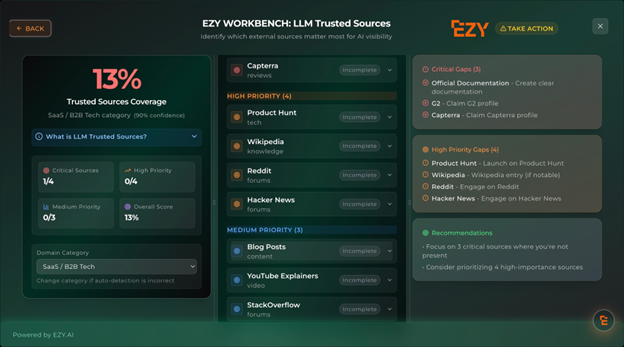
For the complete list of the top LLM sources: https://x.com/ezyaiaeo/status/2015427436322979868?s=20
Works Cited
- AI Overviews Stats & Facts [2025] - WordStream, accessed January 19, 2026, https://www.wordstream.com/blog/google-ai-overviews-statistics
- The Citation Economy in Numbers: 2026 Statistics You Need to Know (All Sourced) - Reddit, accessed January 19, 2026, https://www.reddit.com/r/aiwars/comments/1qciqvu/the_citation_economy_in_numbers_2026_statistics/
- Top Generative AI Chatbots by Market Share – December 2025 - First Page Sage, accessed January 19, 2026, https://firstpagesage.com/reports/top-generative-ai-chatbots/
- ChatGPT Statistics in Companies [January 2026] - Master of Code, accessed January 19, 2026, https://masterofcode.com/blog/chatgpt-statistics
- ChatGPT Users Statistics (January 2026) – Growth & Usage Data - DemandSage, accessed January 19, 2026, https://www.demandsage.com/chatgpt-statistics/
- Google AI Overviews: The Ultimate Guide to Ranking in 2025 - Single Grain, accessed January 19, 2026, https://www.singlegrain.com/search-everywhere-optimization/google-ai-overviews-the-ultimate-guide-to-ranking-in-2025/
- AI Chatbot Market Share 2026: Similarweb Analysis | ChatGPT vs Gemini - Vertu, accessed January 19, 2026, https://vertu.com/lifestyle/ai-chatbot-market-share-2026-chatgpt-drops-to-68-as-google-gemini-surges-to-18-2/
- 67% of ChatGPT's Top 1,000 Citations Are Off-Limits to Marketers (+ More Findings) - Ahrefs, accessed January 19, 2026, https://ahrefs.com/blog/chatgpts-most-cited-pages/
- Is Reddit Dead for SEO and ChatGPT? What the Data Says - AdExpert, accessed January 19, 2026, https://adexpert.io/is-reddit-dead-for-seo-and-chatgpt/
- The Most-Cited Domains in AI: A 3-Month Study - Semrush, accessed January 19, 2026, https://www.semrush.com/blog/most-cited-domains-ai/
- Reddit, Inc.'s back at 22% of ChatGPT citations after dropping to 7-8% in September/October. : r/redditstock, accessed January 19, 2026, https://www.reddit.com/r/redditstock/comments/1p02egq/reddit_incs_back_at_22_of_chatgpt_citations_after/
- AI Citation Data: Why Forums Fail for Buying Intent - Vertu, accessed January 19, 2026, https://vertu.com/lifestyle/the-real-sources-ai-models-trust-for-buying-intent-queries/
- LLM SEO: Get AI Crawled and Ranked in 2025 - Go Fish Digital, accessed January 19, 2026, https://gofishdigital.com/blog/llm-seo/
- 5 steps to get cited in ChatGPT (AI visibility) : r/DigitalMarketing - Reddit, accessed January 19, 2026, https://www.reddit.com/r/DigitalMarketing/comments/1pixhz4/5_steps_to_get_cited_in_chatgpt_ai_visibility/
- https://www.ezy.ai/blog/the-reddit-ranking-resurrection