The word "blog" has started to feel cheap.
Was it written by the founder? An intern? A freelancer? AI? Or worse - an outsourced freelancer using AI to spin out 800 words nobody asked for?
That's the problem EZY's Content Engine solves. Not by creating more content for the sake of it, but by turning real business facts into useful, structured, human-reviewed content that customers can read and AI answer engines can cite.
Here's the dichotomy: there is now far more AI slop versus human-generated content. But small businesses rarely have time to sit and write content from things they've learned this week.
AI answer engines like ChatGPT, Claude, Perplexity, and Google AI Overviews are changing how customers discover businesses. Instead of only clicking through search results, people increasingly ask questions and receive summarised answers. That means your website content needs to work for two audiences: humans reading the page, and machines trying to understand, extract, and cite it.
Would you remember to add Schema to every blog you write? Would you remember to add H2 tags?
EZY starts with what already exists: your website, your services, your public claims, your social posts, and your tone of voice.
Then the Content Engine turns that into structured blog content that is grounded in your facts, written in your style, and reviewed by a human before it goes live.
According to Constant Contact's Q1 2026 Small Business Now report, 54% of small businesses are already using AI and another 27% plan to start using it this year. But using AI is not the same as having a content strategy.
How EZY's Content Engine Solves This
Blogs that are genuinely useful to humans, structured for answer engines, and don't sound like generic AI content.
Here's how we make it real, in summary, before we dig into each piece:
- We ground every blog in real facts about your business (no hallucination) - because we manage your FACTS file
- We optimize the structure so answer engines can more easily understand, extract, and cite your content
- We inject Schema that links each blog to your products and services
- We match your actual writing voice using real samples from your site
- We programmatically check originality so no two blogs sound the same
- We search across your social and online platforms for existing content
- We internally link all of your blogs
- We add the correct structure: H2 tags and clear Q&As
- Alfie Kingsnorth, our in-house content lead, manually reviews every blog before it ships
1. We Ground Every Blog in Your Business Facts - No Hallucination
The single biggest reason AI-generated content fails is hallucination. Models invent a statistic, name a product feature that doesn't exist, or attribute a quote nobody said. This reduces authority and your chance of being cited by an LLMs that fact-checks before quoting.
EZY builds a facts file during your initial signup. We analyse your public website content, extract verified information about your business - founders, products, pricing, customer numbers, geographies, claims you've made publicly - and structure it.
Every time the EZY Content Engine writes a blog, every draft is grounded in your approved business facts. The model doesn't guess - it has real grounding material to draw from. Claims that contradict your facts file are rejected before they ever reach a draft.
For more on the facts layer, see The Fact File: Why EZY.ai's facts.jsonld is the New Standard for AEO.
2. We Optimize for LLM Citation, Not Just Human Reading
Most blog generators write for Google. EZY writes primarily for ChatGPT, Claude, Perplexity, and Google AI Overview - because that's where customers increasingly start their search.
Answer engines are more likely to extract and cite content that is clear, structured, and easy to quote. They preferentially quote:
- Key Takeaways blocks at the top - short factual bullets that stand alone when quoted
- Answer-first H2 sections - where the first sentence directly answers the question implied by the header, in one or two crisp lines
- Named entities (Schema) - specific product names, specific competitors, specific places, not "our solutions" or "industry players"
- Atomic claims - sentences that make sense when quoted out of context, without depending on the sentence before
Every EZY blog is structured exactly this way. The H1 stays declarative (so it's good for Google too). The first sentence under every H2 is the quotable answer. Named entities appear wherever the topic genuinely calls for them.
For the full breakdown of how the widget is built for AEO (Answer Engine Optimization), see Why EZY.ai's Automated Blog Widget Is Built for AEO.
3. We Inject Schema That Links Blogs to Your Products and Services
When crawlers and answer engines access a page, structured data can help clarify what the page is about and how it connects to your products or services. Most blog tools throw a generic BlogPosting Schema on every article - date, author, title, that's it.
EZY does more because we maintain your Schema - including Schema.org Product and Service entities for your business with stable URLs. When the EZY Content Engine writes a blog that genuinely discusses one of your products or services, we link the blog post to those entities via a mentions array in the JSON-LD.
What this means in practice: when an LLMs crawls your blog, it sees structured evidence that the article is about your specific product. That gives answer engines clearer signals about what the article is about and which product or service it connects to.
This is one of the highest-leverage things we do, and it's completely invisible to you or the visitor on your website. Most AEO tools don't do it because it requires linking blog content to entity data on the fly. We do.
4. We Match Your Actual Writing Voice, Not Just "Professional" or "Casual"
Most AI blog tools take a single descriptor - "your brand voice is professional". The result is a generic AI tone.
EZY analyses your homepage and existing public content during onboarding, then stores 500-800 characters of clean prose as a voice sample. Every time the Content Engine generates a blog, EZY matches this voice.
The difference is significant. The model goes from guessing what "professional" means to mimicking how you actually write. Your blogs sound like you.
5. We Check Originality Programmatically - No Two Blogs Sound the Same
AI slop is everywhere because most tools don't check what they've already written. They'll happily generate a structurally identical article with a different title, and the user has no idea.
We also run a post-generation similarity check to make sure new posts do not repeat the same structure or ideas too closely.
The result: every blog is genuinely fresh. Not just at the title level - at the structural and semantic level.
6. Alfie Reviews Every Single Blog Manually
Here's the part most AEO tools won't tell you. Software can do a lot, but it can't do everything. Some judgements - does this sentence actually land, does this argument hold up, is this claim defensible - still need a human.
So Alfie Kingsnorth, our in-house content lead, manually scans every blog before it goes live. He's not just spell-checking - he's checking that the post sounds like your brand, that the argument actually works, that nothing slipped through the originality check, that the calls to action are sharp.
AI-only content tools optimize for volume. EZY optimizes for answer engines.
Why All of This Adds Up to Something Different
EZY.ai produces blogs that:
- Don't hallucinate, because they're grounded in your facts
- Get cited by LLMs, because they're structured for citation
- Drive product-specific authority, because they're linked to your products via Schema
- Sound like you, because they're voice-matched to your real writing
- Stay original, because we check programmatically that they do
- Pass human judgement, because Alfie reads every one
This is what we mean when we say EZY isn't a blog generator. It's a content engine designed for a world where AI search is how customers find you - and where the bar for trustworthy content has just gone up, not down.
You can spend hours writing one blog. Or you can let EZY ship 4 per month, each one engineered to be cited, voice-matched to your brand, and reviewed by a human before publishing.
Where have all the humans gone? Some of them are at EZY, making sure your content still reads like one wrote it.
The EZY Content Engine Workbench
The Workbench alone took almost 12 months of development, UI/UX, logic, and design to perfect. From your blogs we can then measure:
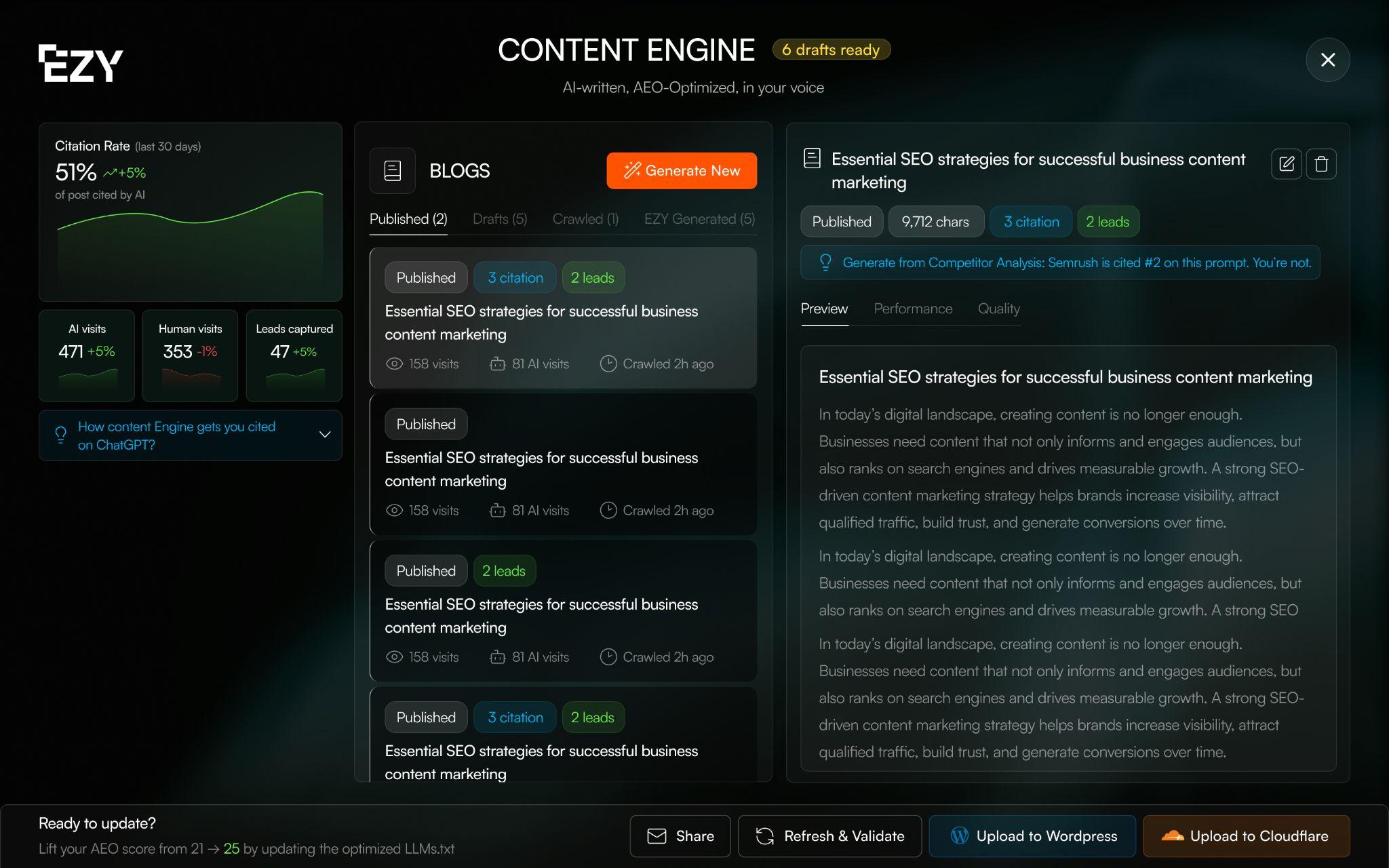
- Visits to every blog
- AI-referred (human) visits to every blog
- AI crawler visits to every blog (see AI Agents for how we detect and track them)
- Leads captured from each blog
To Summarise
The hard part is not generating a blog. Anyone can do that now.
The hard part is generating content that works for humans and machines: grounded in real business facts, structured for answer engines, connected to your products and services, reviewed by a human, and measured after publication.
That is why we built the EZY Content Engine as a full workflow, not a writing tool.
From the Workbench, you can see which blogs are live, which are being crawled, which are driving AI-referred visits, and which are capturing leads.
That means your content is no longer guesswork. You can see what is being published, what AI systems are touching, and which posts are actually creating commercial value.